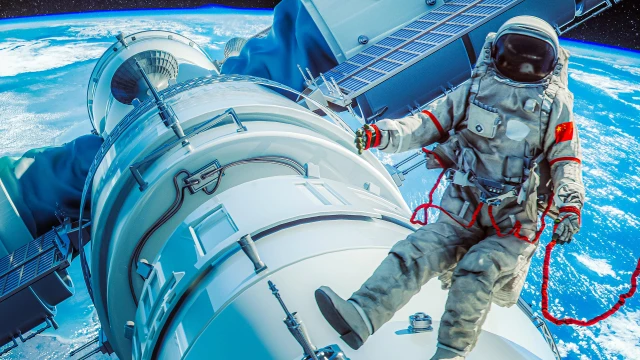
China’s Tiangong Space Station Emerges as a Global Leader in Space Innovation
As space exploration intensifies worldwide, China’s Tiangong (“Heavenly Palace”) space station is quickly asserting its place at the forefront—scientifically, technologically, and diplomatically. Over recent months, Tiangong has made headlines for significant scientific breakthroughs, viral controversies, and the development of self-defense technology in orbit.
Bacteria with Space-Specific Adaptations Discovered on Tiangong
Earlier this year, scientists made a startling discovery aboard Tiangong: a previously unidentified strain of bacteria that had adapted to survive in the harsh conditions of space. Found by astronauts during the Shenzhou-15 mission in 2023, the microbes were collected using sterilized wipes, frozen, and returned to Earth for analysis.
The bacteria were determined to be a space-adapted strain of Niallia circulans, a spore-forming bacterium typically found in soil and sewage. While harmless in most cases, Niallia circulans can cause sepsis in immunocompromised individuals. The newfound strain—dubbed Niallia tiangongensis—showed specific adaptations for space survival, including genes that aid in oxidative stress management, DNA repair from radiation, and biofilm formation.
The findings, published in the International Journal of Systematic and Evolutionary Microbiology, underscore the importance of monitoring microbial evolution during long-term space missions to ensure astronaut safety and spacecraft integrity.
Water Controversy Sparks Space Conspiracy Theories Online
In a separate but widely discussed incident, a video posted by Chinese state media showing a glass of water on Tiangong ignited a wave of online conspiracy theories. Critics argued that the water’s stillness disproved microgravity, fueling claims that the footage was staged on Earth.
However, physicists and space researchers quickly dispelled these theories. The water’s behavior was due to surface tension and adhesion to the glass—well-documented properties in microgravity. The clip was part of a Tiangong Class educational program where astronauts demonstrated buoyancy using a ping-pong ball suspended in water.
Despite rational explanations, the controversy highlighted the persistent skepticism surrounding space achievements—and the need for public science literacy.
China’s Robotic Space Defense Plans Revealed
Amid growing concerns about space security, Chinese scientists are also preparing Tiangong for potential threats. Sun Zhibin of the National Space Science Centre revealed that China is developing robotic thrusters capable of intercepting suspicious spacecraft approaching their orbital infrastructure.
These mini-bots would latch onto objects deemed a threat—whether accidental or deliberate—and push them to a safe distance. The proactive defense system is designed to protect vital scientific operations and assert China's growing influence in space security policy.
Shenzhou XX Crew Conducts Cutting-Edge Experiments
Currently aboard the Tiangong station are astronauts Chen Dong, Chen Zhongrui, and Wang Jie, who have now spent over 50 days in space. Far from idle, the crew is conducting crucial scientific experiments in cognitive science, cardiovascular health, and microbiology.
Their research includes studying how microgravity affects decision-making, motion perception, and team coordination—essential for future deep-space missions. On the biomedical front, they’re investigating how microorganisms grow and behave in space, with a focus on Streptomyces, known for producing antibiotics.
Astronauts also maintain strict exercise routines and undergo regular medical checkups, including heart monitoring and Traditional Chinese Medicine assessments. According to the China Manned Space Agency, Tiangong has hosted over 200 scientific projects to date, returning nearly 100 samples to Earth.
Conclusion: A New Era of Chinese Space Leadership
From microbiological discoveries to cutting-edge defense tech, the Tiangong Space Station is not just a symbol of China’s ambitions—it’s a hub of global scientific advancement. As international space politics evolve and commercial space travel edges closer to reality, Tiangong’s contributions may well shape the next chapter of humanity’s journey beyond Earth.