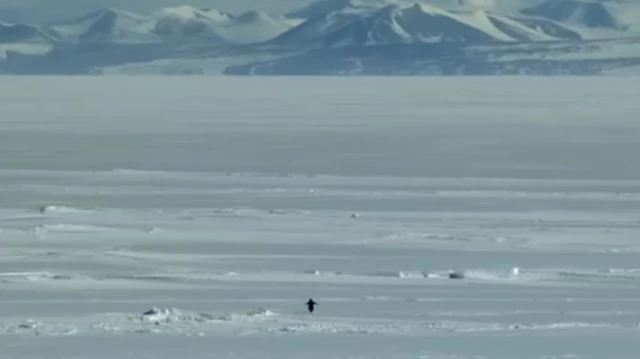
A short clip of a penguin walking alone toward distant icy mountains has become one of the most unexpected viral sensations of 2026. Online users have dubbed it the “Nihilist Penguin,” turning the moment into a symbol of emotional exhaustion and quiet rebellion.
The footage comes from Werner Herzog’s 2007 documentary Encounters at the End of the World. In the scene, an Adélie penguin breaks away from its colony and heads inland, roughly 70 kilometers from the ocean that provides its food and survival. The landscape ahead is barren and frozen, making the journey appear deliberate and mysterious.
Social media has embraced the image with captions suggesting the penguin has “given up,” rejected purpose, or chosen isolation. The meme resonates in a time when conversations about burnout, mental fatigue, and stepping away from expectations dominate online culture. Many viewers see their own struggles reflected in the penguin’s quiet walk.
Scientists, however, offer a very different explanation. Wildlife experts say such behavior, while rare, has been observed in penguins and other animals. Disorientation, illness, neurological issues, or stress during breeding seasons can cause individuals to wander in unsafe directions. Penguins rely heavily on environmental cues, and when those cues fail, their instincts can mislead them.
Herzog himself described the scene as a tragic outcome rather than a symbolic act, noting that penguins traveling inland are unlikely to survive. Biologists caution against projecting human emotions onto animal behavior, a tendency known as anthropomorphism.
To researchers, the clip represents individual variation rather than a sign of broader danger to penguin populations. It does not suggest a new pattern of behavior or an environmental crisis on its own.
Yet the meme’s popularity highlights something deeper about modern audiences. Viewers are not responding to the penguin’s biology but to what they feel it represents. In turning a lost animal into a cultural symbol, the internet has transformed a moment of confusion into a mirror of contemporary life.
The penguin is not making a statement or rejecting existence. It is simply moving in the wrong direction. But the way millions interpret that movement reveals how powerfully people search for meaning in even the smallest images.


