Key Points:
-
UAE Foreign Ministry rejects Bloomberg claims as “false and misleading”
-
Officials say multi-layered air defense systems remain fully operational
-
Statement comes during third day of regional missile and drone escalation
Sharjah, United Arab Emirates: By late afternoon, security vehicles were stationed outside key government buildings while air defense chatter circulated across regional monitoring channels. Inside the Ministry of Foreign Affairs, officials moved to counter what they described as inaccurate reporting about the country’s defensive posture.
In a statement issued hours after the latest round of regional missile interceptions, the ministry categorically rejected what it called “false and misleading claims” published by Bloomberg regarding the UAE’s defense capabilities.
“The unfounded assertions misrepresent the UAE’s high level of preparedness, technological sophistication and operational readiness,” the statement said.
Officials stressed that the country operates “diverse, integrated and multi-layered air defense systems” capable of countering a full spectrum of aerial threats. Long, medium and short-range systems function together to provide what the ministry described as comprehensive protection of national airspace.
The clarification comes as Gulf states face sustained aerial threats for a third consecutive day following Iranian missile and drone launches targeting multiple countries in the region.
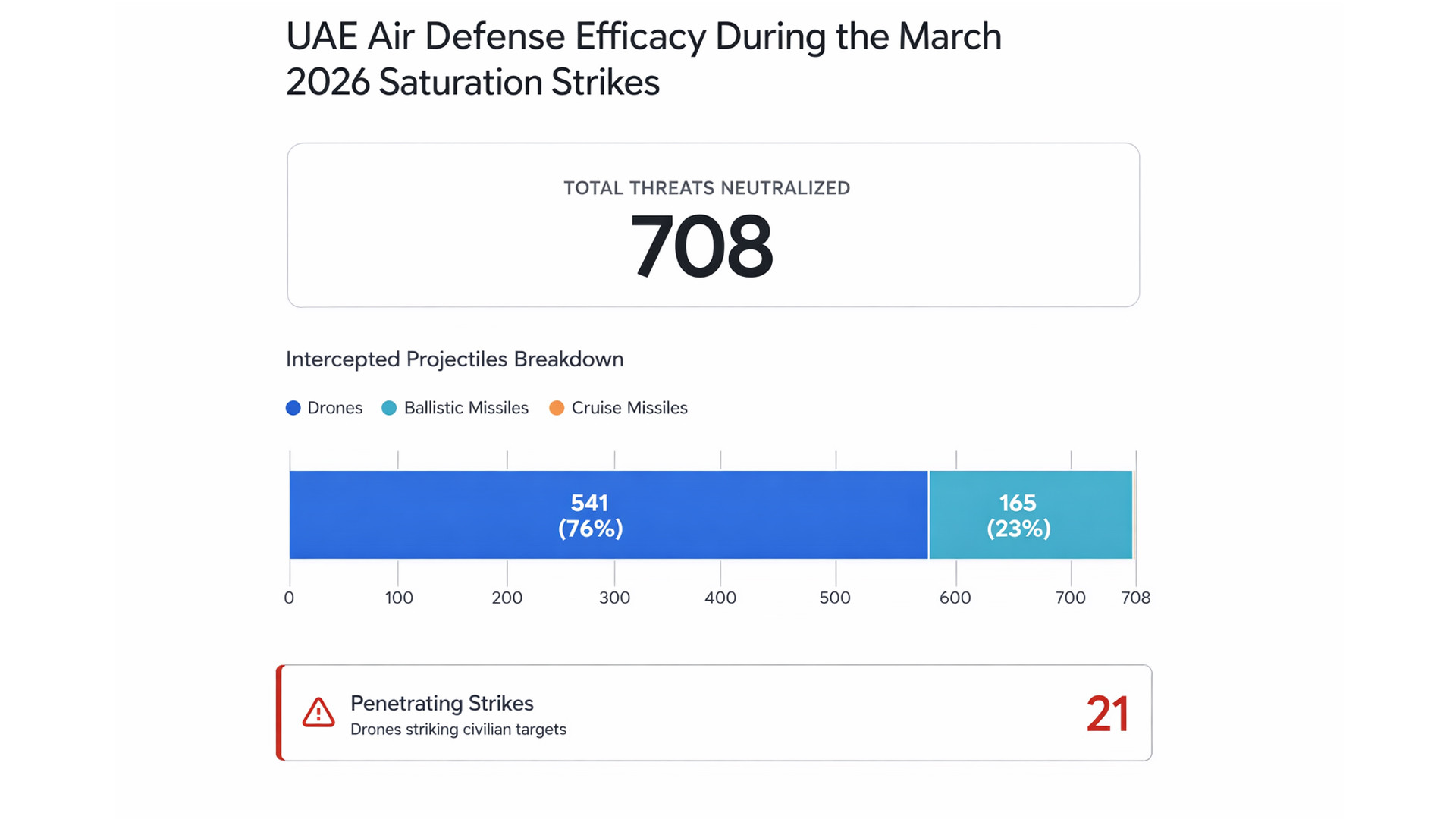
A defense performance graphic circulated by officials outlines the total volume of Iranian projectiles intercepted by UAE air and missile defense systems between February 28 and March 2, 2026.
According to the data, despite facing what was described as a highly coordinated saturation attack involving hundreds of distinct vectors, interception rates remained extraordinarily high, limiting structural damage to isolated incidents.
Interception systems were activated across the UAE, Bahrain, Saudi Arabia, Kuwait and Qatar, according to regional defense updates.
The ministry added that the UAE maintains a robust strategic stockpile of munitions designed to ensure sustained interception capacity over extended periods. It reaffirmed that operational readiness remains intact and national security frameworks are uncompromised.
Anwar Gargash, diplomatic adviser to the UAE President, addressed the broader climate in a post on X, saying crises reveal “true intentions” and test who genuinely stands with Gulf stability. He suggested that some ideological movements prioritize their own agendas over regional security during moments of strain.
Defense analysts note that perception plays a measurable role in deterrence economics. Even minor speculation about air defense gaps can influence insurance premiums for shipping lanes and aviation risk assessments. During previous regional escalations, war risk insurance adjustments moved by 3.6 percent within 48 hours of heightened threat reporting.
What this changes
Publicly rebutting a major financial news outlet signals that the UAE views narrative control as part of its deterrence strategy. In periods of active missile exchange, market psychology can shift faster than battlefield conditions. Governments move quickly to prevent misinterpretation from affecting investor confidence, energy flows and airspace operations.
While defense systems have maintained an interception rate exceeding 90%, the scale of the saturation attacks has not been without human cost. The Ministry of Defense confirmed that falling debris and localized impacts have resulted in three fatalities, identified as Pakistani, Nepali, and Bangladeshi nationals, and several dozen minor injuries. In response to the persistent aerial threat, the UAE’s aviation landscape remains heavily restricted. Emirates and Etihad Airways have extended the suspension of most commercial departures until at least March 4, though authorities announced a 'limited resumption' of special repatriation and cargo flights today. Travelers are being strictly advised not to head to airports unless they have received direct confirmation of a scheduled flight from their carrier.
Why this matters now
The Gulf is navigating one of its most fragile security periods in recent years. Missile exchanges, drone interceptions and expanded regional military coordination are unfolding simultaneously. In this environment, defense credibility is not abstract. It directly affects oil corridor stability, aviation routing and regional diplomacy. Any suggestion of weakness carries economic and geopolitical consequences.
On the ground, there were no confirmed disruptions to commercial airports, and air traffic continued under monitored conditions. Residents reported hearing distant interception activity overnight, though authorities stated systems performed as designed.
The broader confrontation involving Iran, the United States and Israel continues to heighten concerns about a wider regional spillover. Gulf governments have intensified coordination and reiterated calls for restraint.
The UAE’s message was clear: its defensive infrastructure remains steady despite the regional escalation.