Key Points
-
Israeli strikes reportedly hit around 30 Iranian oil storage tanks in Tehran
-
Fires erupted at a refinery complex near the Iranian capital
-
Conflict involving Iran, Israel, and the United States continues to expand across the Gulf
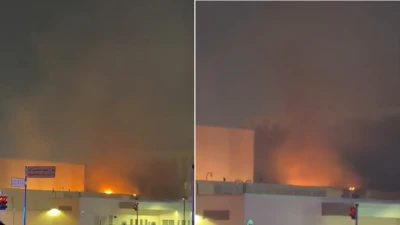
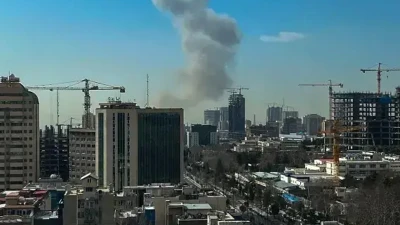
Tehran: A major fire erupted at an oil facility near Tehran after Israeli forces reportedly struck multiple Iranian fuel storage tanks, according to video footage, circulating across international media and social platforms.
The footage, broadcast by several international networks, shows thick black smoke rising above the refinery complex as flames spread across large fuel storage areas.
A Tehran oil refinery is on fire pic.twitter.com/5n5VwaLTQG
— Open Source Intel (@Osint613) March 7, 2026
Early reports indicate that around 30 oil storage tanks may have been targeted during the strike, though Iranian authorities have not yet released an official damage assessment.
Energy infrastructure attacks represent a significant escalation in the conflict because they directly threaten domestic fuel supply and global oil markets.
The targeted facility is believed to be part of the Shahr-e Rey oil refinery area south of Tehran, one of the largest fuel processing hubs supplying the Iranian capital.
Emergency crews were seen responding to the blaze as the fire continued burning across several sections of the facility.
War Expands Into Energy Infrastructure
The latest strike comes as the widening confrontation involving Iran, Israel, and the United States enters its second week.
Military officials say Israeli operations have increasingly targeted strategic Iranian infrastructure in addition to military sites.
Defense analysts note that attacks on refineries and fuel storage sites could place significant pressure on Iran’s internal energy supply and logistics network.
Despite the strikes, journalists reporting from Tehran say daily life in the capital remains relatively calm.
Markets, transportation, and public services are still operating, and there have been no confirmed reports of widespread shortages of food or fuel.
US Military Campaign Intensifies
Military officials in Washington say the United States has conducted large-scale strikes on Iranian military infrastructure using long-range bombers and precision weapons.
According to regional defense briefings, B-2 stealth bombers dropped dozens of 2,000-pound bunker-penetrating bombs targeting underground missile launch facilities believed to be hidden inside mountainous terrain.
US Central Command says these strikes have significantly reduced Iran’s ability to launch long-range attacks.
- Missile launches have reportedly fallen about 90 percent compared with the first day of the conflict
- Drone attacks have declined approximately 83 percent
- Several Iranian naval vessels have also been destroyed during operations in the Gulf and surrounding waters
Military analysts say the campaign is one of the most technologically intensive air operations conducted in the Middle East in recent years.

Economic Cost of War Mounts
The financial impact of the conflict is rapidly growing for both the United States and Israel.
Estimates cited in defense and economic briefings suggest the United States is spending approximately $891 million per day on military operations related to the conflict.
Within the first week alone, combined operational costs and economic disruptions have already reached about $53 billion, with analysts warning that the overall cost could climb to between $100 billion and $210 billion if the war continues.
Israel is also experiencing heavy economic pressure as security restrictions disrupt daily life.
Economic researchers estimate the Israeli economy is losing roughly $3 billion per week due to school closures, suspended flights, and the mobilization of thousands of military reservists.
Several missile strikes have reportedly hit areas near central Tel Aviv and Ben Gurion Airport, forcing temporary security shutdowns and causing localized infrastructure damage.

Gulf Region Faces Growing Security Threats
The conflict has increasingly spilled into the Gulf, where several countries host key American military installations.
Regional defense reports indicate that Iranian missiles and drones have targeted multiple strategic locations:
- Qatar: An early-warning radar system valued at about $1.1 billion at Al-Udeid Air Base was reportedly destroyed
- United Arab Emirates: A $500 million missile defense radar in Al-Ruways Industrial City was hit
- Bahrain: Missile strikes reportedly damaged infrastructure near the US Fifth Fleet headquarters and an oil refinery facility
- Saudi Arabia: Air defense systems intercepted drones and a cruise missile over Riyadh and Al-Kharj
Security officials across the Gulf have raised alert levels while air defense systems remain on standby for additional attacks.
Energy Markets Under Pressure
One of the biggest global impacts of the conflict has been the threat to shipping routes in the Strait of Hormuz, one of the world’s most critical energy corridors.
About 20 percent of global oil shipments pass through the narrow waterway connecting the Persian Gulf to international markets.
Since the conflict began, Brent crude oil prices have surged roughly 25 percent to around $93 per barrel, while natural gas prices have jumped more than 60 percent within a week.
Energy officials warn prices could rise further if tanker traffic is disrupted.
Qatar’s energy minister cautioned that prolonged instability in the Strait could potentially push oil prices toward $150 per barrel, a level not seen since major global supply shocks.
Aviation and Tourism Disruptions
The conflict has also created severe disruption for international travel across the Gulf.
Airlines have rerouted or canceled thousands of flights to avoid missile and drone corridors.
Regional aviation authorities estimate that more than 23,000 flights have been canceled, leaving tens of thousands of passengers stranded across major hubs including Dubai International Airport.
Tourism analysts warn the broader economic consequences could be severe. Early projections suggest the Middle East travel industry could face losses between $34 billion and $56 billion this year if instability continues.

Strategic Oil Shift Involving India and Russia
In a significant geopolitical move aimed at stabilizing global energy supply, the United States has temporarily eased restrictions on Russian oil shipments to India.
Under a 30-day waiver, Indian refineries are permitted to import Russian crude to offset potential shortages caused by the conflict and uncertainty around Iranian exports.
Energy analysts say the policy adjustment reflects Washington’s effort to prevent a global supply shock while maintaining pressure on Tehran during the ongoing conflict.
As military operations continue and diplomatic tensions deepen, analysts warn that the war’s economic ripple effects may extend far beyond the Middle East, affecting global trade, energy prices, and financial markets in the weeks ahead.