Key Points
-
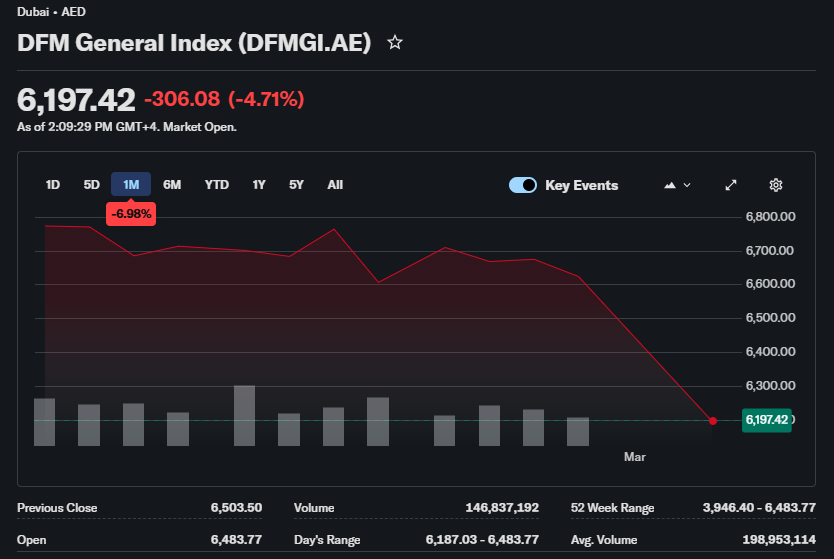
Dubai Financial Market General Index fell about 4.7 percent during trading on March 4
-
Major UAE-listed companies including Emaar Properties declined nearly 5 percent
-
Escalating regional conflict and energy market volatility added pressure on Gulf markets
Dubai, United Arab Emirates: Selling pressure swept across the Dubai Financial Market on Tuesday afternoon as investors reacted to rapidly escalating geopolitical tensions across the Gulf, pushing the emirate’s main equity index sharply lower during active trading.
The Dubai Financial Market General Index dropped to around 6,197 points, down roughly 306 points or 4.71 percent, according to market data recorded during the trading session. The decline marked one of the steepest intraday drops for the benchmark index in recent weeks.
Heavy losses were also visible among several widely traded UAE-listed companies.
Shares of Dubai Financial Market PJSC were trading near 1.53 AED, down almost 4.97 percent, while property giant Emaar Properties PJSC slipped to about 15.40 AED, a decline of roughly 4.94 percent during the same session.
Trading floors and brokerage desks across the emirate reported heightened caution among investors as the regional security situation continued to deteriorate through the day.
Several traders said the selling pressure intensified during the afternoon session as breaking geopolitical developments began circulating through global financial markets.
“There is a clear risk-off sentiment right now,” one Dubai-based equities trader said, noting that investors were closely monitoring regional security updates before placing large positions.
Analysts said markets across the Gulf tend to react quickly to geopolitical shocks because of the region’s close ties to global energy flows and shipping routes.
The Strait of Hormuz, located just north of the United Arab Emirates, remains one of the world’s most critical oil transit corridors, and any perceived threat to the waterway can trigger rapid movements in both oil and equity markets.
Market participants said uncertainty surrounding the widening conflict has also begun influencing energy prices and global investor sentiment.
Conflict Escalation Raises Regional Risk
Financial markets were reacting to a cascade of military and diplomatic developments reported across the region over the past several hours.
US President Donald Trump confirmed that American forces carried out what he described as a “substantial” strike targeting Iran’s new leadership, claiming that Iran’s military capabilities had been significantly degraded.
At the same time, Israeli forces reportedly carried out airstrikes against senior Iranian leadership gatherings during an ongoing leadership meeting, according to regional security reports.
The conflict has also begun affecting neighboring countries and key strategic infrastructure.
Authorities in the United Arab Emirates said their air defenses intercepted 11 ballistic missiles and 123 drones in a single day, highlighting the scale of aerial threats emerging across the region.
Meanwhile, energy markets briefly surged after fears that tensions could disrupt oil flows through the Strait of Hormuz, one of the world’s busiest energy shipping routes.
Oil prices initially jumped sharply before partially retreating after Washington announced that US naval forces would escort tankers through the Gulf if necessary.
Global energy markets are also monitoring reports that Iraq may shut down Rumaila oil field, one of the largest oil-producing sites in the world, which could potentially remove around 3 million barrels per day from global supply if disruptions continue.
Aviation and Travel Disruptions
The security situation has also triggered significant disruption to international travel.
More than 1 million travelers are reported stranded across the region, with approximately 1,900 flights canceled as airspace restrictions and security concerns spread through major Gulf aviation hubs.
The US State Department said it is arranging charter flights from the United Arab Emirates, Saudi Arabia, and Jordan to assist American citizens attempting to leave the region.
Investors Watching Regional Developments Closely
Financial analysts say the direction of Gulf markets in the coming sessions will likely depend heavily on whether the conflict stabilizes or continues to escalate.
Investors are also monitoring signals from global central banks and commodity markets after US Federal Reserve official Neel Kashkari indicated that the conflict could complicate expectations for interest rate cuts this year.
For now, traders say markets remain highly sensitive to every new headline emerging from the region.
With geopolitical developments unfolding rapidly, market volatility across the Gulf is expected to remain elevated in the near term.