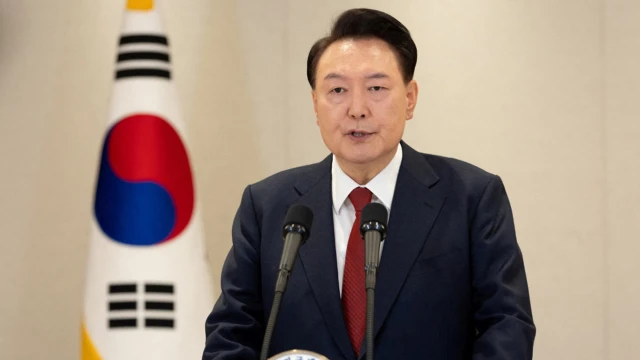
Seoul, South Korea: Former president Yoon Suk Yeol was sentenced to life imprisonment after a court found he masterminded an insurrection by attempting to impose martial law in December 2024.
Presiding judge Ji Gwi-yeon said the former leader had “fundamentally damaged the democratic order,” calling him the insurrectionist leader behind the decision to deploy military troops to surround the National Assembly. Prosecutors had sought the death penalty, but the court imposed life imprisonment instead.
The case centers on events of 3 December 2024, when Yoon declared martial law during a live televised address. Military units were ordered to seal off parliament and arrest key political figures. Lawmakers forced their way into the chamber and voted down the order within hours, reversing the decree before it could fully take effect.
Security was heavy outside the courthouse during sentencing. Around 1,000 police officers were deployed, and rows of police buses formed a barrier to control crowds. Supporters gathered early in the morning holding banners that read “Yoon, again,” while opponents demanded the maximum punishment. Some supporters were seen in tears after the verdict was announced.
Inside the courtroom, Yoon showed little reaction. His lawyers argued the ruling was not supported by sufficient evidence and said they would consider an appeal. Under South Korean law, both sides have one week to challenge the decision, meaning the case could move to the Supreme Court and take months to conclude.
During the trial, Yoon defended his actions, insisting that as president he had the constitutional authority to declare martial law. He said the move was necessary to protect the country from what he described as anti-state forces and political obstruction. The court rejected that argument, ruling that the declaration lacked legal justification.
Several senior officials were also convicted in connection with what judges described as an “insurrection from the top.” Former prime minister Han Duck-soo received a 23-year prison term, while other cabinet and security officials were handed lengthy sentences for their roles.
South Korea has not carried out an execution since 1997, meaning even a death sentence would likely have resulted in life behind bars. Political analysts in Seoul note that previous presidents convicted of crimes were later pardoned after serving a few years, leaving open the possibility that this case could follow a similar path.
For now, the life sentence marks one of the most significant rulings in South Korea’s modern political history and reflects the deep divisions that continue to shape the country’s democracy.


