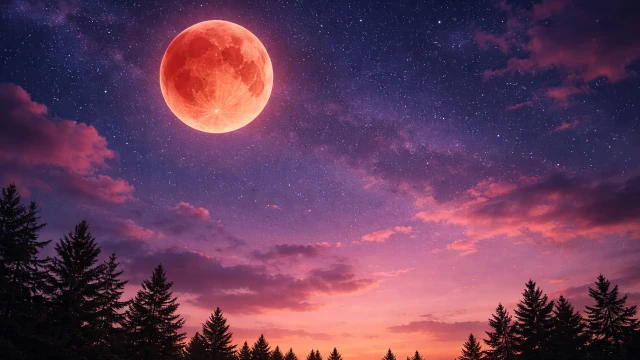
New York: Early risers across North America will get a front row seat to one of the year’s most striking sky events when a total lunar eclipse paints the moon deep red on March 3.
The celestial show, often called a blood moon, will unfold during the pre dawn hours, with astronomers saying the dramatic color shift occurs when Earth moves directly between the sun and the moon.
Unlike solar eclipses, the event is completely safe to view with the naked eye, making it accessible to casual skywatchers and seasoned observers alike.
When and where to watch
According to timing projections, the partial eclipse will begin at 4:50 a.m. Eastern Time. Totality, the phase when the moon turns its deepest red, is expected to start at 6:04 a.m. and peak around 6:33 a.m. The moon will gradually exit Earth’s shadow after 7:02 a.m.
North and Central America are expected to have the best visibility, while viewers in Australia and eastern Asia will see the eclipse during evening hours. Much of Europe and Africa will miss the event entirely.
Why the moon turns red
During a total lunar eclipse, sunlight bends through Earth’s atmosphere before reaching the moon. Shorter blue wavelengths scatter, while longer red and orange wavelengths pass through and illuminate the lunar surface.
The effect mirrors the colors seen during sunrise and sunset, giving the moon its copper red glow.
The Worm Moon connection
March’s full moon is traditionally known as the Worm Moon, a name rooted in Native American seasonal observations marking the time when thawing soil reveals worm trails and signals the approach of spring.
This combination of the seasonal full moon and total eclipse makes the March event especially notable for skywatchers.
Why this eclipse matters now
Astronomers note this will be the last total lunar eclipse visible worldwide until December 31, 2028, adding urgency for viewers hoping to witness the phenomenon.
Officials recommend finding a dark location away from city lights for the clearest view, though the eclipse will remain visible even in urban areas if skies stay clear.


