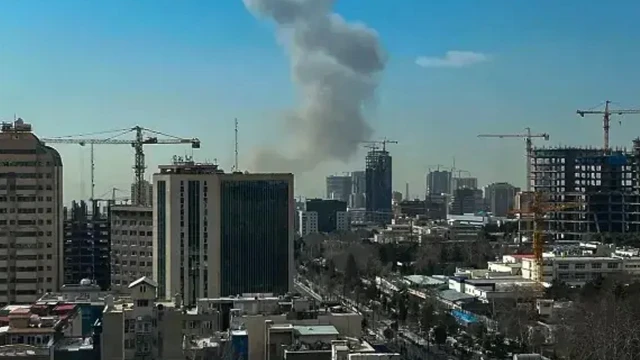
Key Points:
-
US and Israel carried out coordinated strikes on Iranian military targets.
-
Iran launched missile and drone retaliation, including toward a US base in Bahrain.
-
President Trump called the campaign “massive and ongoing” and warned of risks.
The United States and Israel launched what officials described as a major coordinated military operation against Iran early Saturday, escalating tensions across the Middle East and putting American forces in the region on heightened alert.
President Donald Trump confirmed the campaign in a video address, calling the strikes “massive and ongoing” and warning that US casualties were possible. The operation follows months of what the Israeli military described as close joint planning between Washington and Tel Aviv.
“Our objective is to defend the American people by eliminating immediate threats from the Iranian regime,” Trump said.
Iran responds with missiles and drones
Within hours of the opening strikes, Iran’s Islamic Revolutionary Guard Corps announced it had launched the “first wave” of large scale missile and drone attacks toward Israel.
A US official confirmed that an Iranian missile attack targeted the US Navy’s Fifth Fleet base in Bahrain, calling the situation active. Explosions were also reported in Bahrain, Abu Dhabi and Qatar, all locations that host American military facilities.
Regional air defenses were activated, and several Gulf states moved quickly to close or restrict airspace as the situation intensified.
What the US operation is targeting
The Israel Defense Forces said the campaign is aimed at degrading Iranian military capabilities and removing what it called existential threats. Fighter jets were still striking targets across Iran hours after the initial wave.
Two sources familiar with US planning said the military is preparing for several days of continued operations, signaling the confrontation could extend well beyond the initial strikes.
Iran has repeatedly denied seeking nuclear weapons, but US officials argue Tehran has been working to rebuild elements of its nuclear and missile programs.
Political reactions build in Washington
The military action quickly drew strong reactions in Washington. Senator Lindsey Graham, a longtime Trump ally, called the operation “necessary and long justified.”
Trump went further in his address, urging Iranians to “take over your government,” a statement likely to inflame tensions further with Tehran.
Why this matters now
The strikes mark one of the most direct US military confrontations with Iran in years and raise immediate concerns about the safety of American troops stationed across the Gulf.
With US bases already coming under missile threat and operations expected to continue for days, officials are bracing for possible escalation that could affect global energy markets and regional stability.
For now, the Pentagon has not released casualty figures, and the full scope of damage on either side remains unclear as the situation continues to develop.
LIVE UPDATE
Explosions Reported Across Gulf as Iran Expands Retaliation
Explosions were reported across multiple Gulf countries late Saturday as Iran widened its retaliation following the joint US and Israeli airstrikes, raising fresh concerns about the safety of American military assets in the region.
Officials and regional media reported blasts in Doha, Kuwait City, Abu Dhabi and Manama. The developments came hours after Iran’s Islamic Revolutionary Guard Corps announced it had launched the first wave of missile and drone attacks in response to the US led operation.
Qatar’s defense ministry said it had successfully repelled “a number of attacks” targeting its territory. A Qatari official confirmed that air defenses intercepted two Iranian missiles over the country, while AFP journalists reported hearing explosions across Doha.
Videos of Iran’s attack on Bahrain. pic.twitter.com/h50aPU9QtH
— Ihtisham Ul Haq (@iihtishamm) February 28, 2026
US Fifth Fleet site hit in Bahrain
Bahrain confirmed that a service center linked to the US Navy’s Fifth Fleet headquarters was struck in what it described as a missile attack. Authorities said additional details would be released later.
Iran’s semi official Fars news agency also reported that Iranian forces had targeted the US facility, signaling a direct challenge to American military presence in the Gulf.
AFP correspondents reported another explosion in Manama shortly after the initial strike.
Airspace closures and regional alerts
As tensions surged, Qatar, Kuwait and the United Arab Emirates moved to close their airspace as a precautionary measure. Sirens were also activated in Kuwait following reports of explosions.
Witnesses in Saudi Arabia reported hearing loud blasts in Riyadh, though officials there have not yet confirmed any strike.
Situation remains highly volatile
The expanding geographic spread of the explosions underscores fears that the confrontation could broaden into a wider regional conflict involving US forces and key American allies.
Pentagon officials have not yet released updated damage assessments, and it remains unclear whether additional Iranian strikes are imminent.
Editor’s note: This is a developing situation and the story will be updated as more confirmed information becomes available.


